
2Pcs ADS1115 16 Bit I2C Module
5.0Editor score
16 Bit resolution precision
4 Channel analog input
Wide voltage supply range
Compare the top ten Arduino ADC boards featuring 16 and 24 bit resolution to find the best analog to digital converter module for your sensors.
Arduino ADC boards allow microcontrollers to read analog signals with high precision. These modules convert voltage levels into digital data for processing. Choosing the right board depends on your sensor type and sampling needs.
This guide compares ten highly rated modules available for makers and engineers. We evaluated resolution, channel count, communication interfaces, and overall reliability. Each selection aims to help you find the perfect fit.
Every entry below highlights key specifications and real world applications. Prices fluctuate regularly so check current listings before buying. Use this list to streamline your electronics prototyping process today.
5.0Editor score

4.7Editor score

4.6Editor score
The following table provides a side by side comparison of all selected ADC modules. Review specifications such as channel count and interface type to determine the best fit for your specific project requirements.


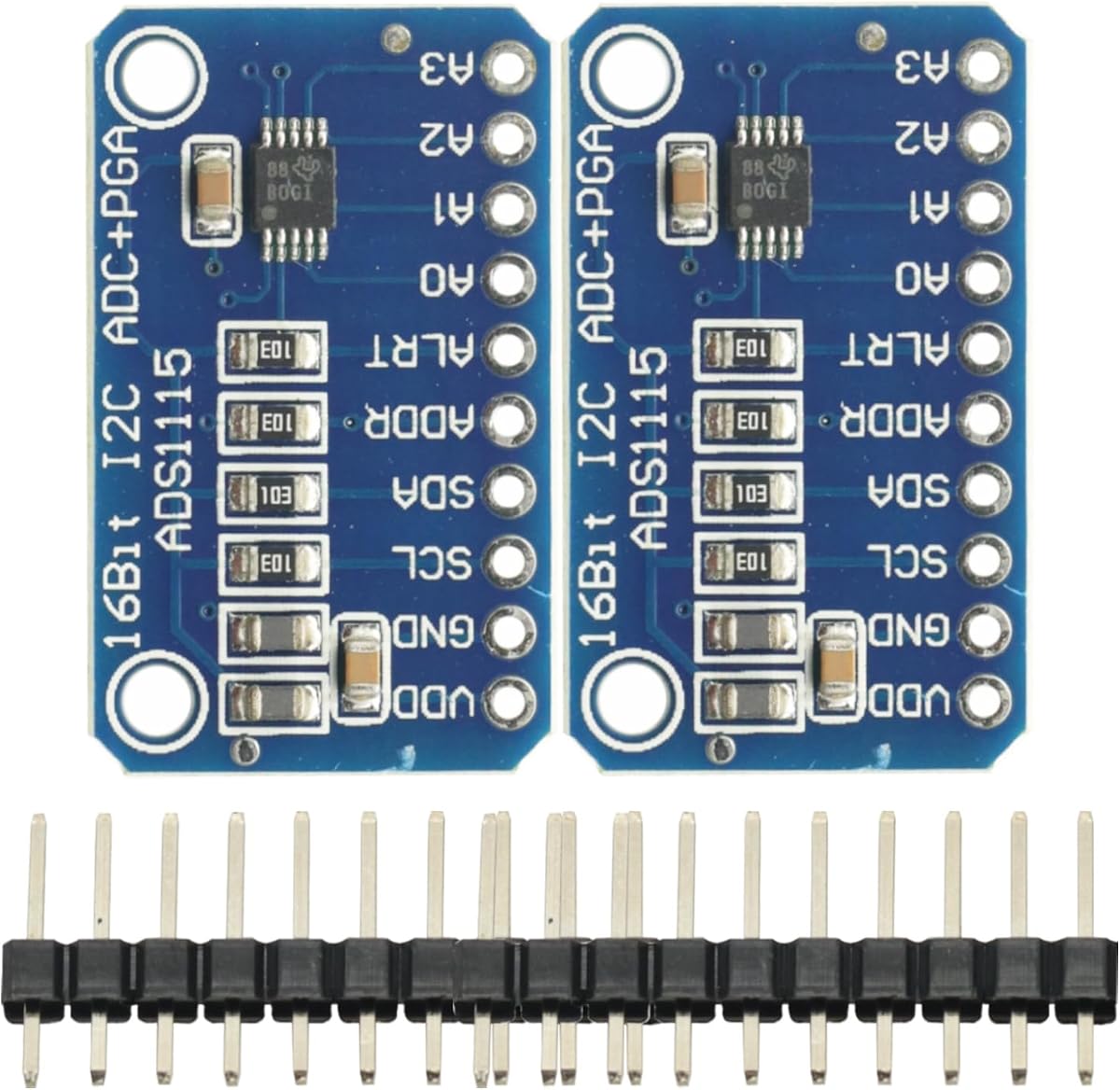


This ADS1115 module is a top rated choice for analog to digital conversion. It offers 16 bit resolution with a programmable gain amplifier for flexible voltage measurements. The I2C interface simplifies wiring for most Arduino and Raspberry Pi projects.
We may earn a commission when you buy through this link, at no additional cost to you.
The onboard PGA allows you to adjust input ranges from millivolts to several volts. This makes it ideal for low voltage sensors like thermocouples or strain gauges. Users appreciate the wide supply voltage range which ensures compatibility with various logic levels.
While the data rate caps at 860 samples per second it is sufficient for most sensor monitoring tasks. The compact size saves board space but requires careful layout for optimal performance. Single shot mode helps conserve power in battery powered applications.
Buy this board if you need reliable high resolution readings without complex wiring. It is a great starting point for data logging and precision measurement systems. The pack of three ensures you have spares for larger projects.
The 16 bit resolution allows detection of tiny voltage changes for accurate readings.
Supports supplies from 2.0 to 5.5 volts making it work with 3.3V and 5V systems.
We may earn a commission when you buy through this link, at no additional cost to you.
The ADS1256 module stands out for its exceptional 24 bit resolution. This allows extremely accurate measurements suitable for professional instrumentation. Eight input channels provide versatility for multi sensor data acquisition setups.
We may earn a commission when you buy through this link, at no additional cost to you.
It features a stable internal reference voltage which improves measurement consistency. The low nonlinearity ensures readings remain accurate across the full input range. Differential input support helps reject noise from long sensor wires.
SPI communication offers faster data rates than I2C but uses more pins. The module requires 5V logic so level shifters might be needed for 3.3V microcontrollers. Setup is more involved than simpler boards but worth the precision.
Choose this board for industrial applications requiring high accuracy and many channels. It excels in monitoring multiple analog signals simultaneously. The performance justifies the extra setup effort for critical measurement tasks.
24 bit resolution captures minute voltage variations for laboratory level accuracy.
Eight channels allow monitoring of complex systems without multiple separate boards.
We may earn a commission when you buy through this link, at no additional cost to you.
This budget friendly option delivers the same core features as other ADS1115 boards. It achieves perfect ratings for reliability and ease of use in hobbyist projects. The 16 bit conversion handles most standard sensor applications well.
We may earn a commission when you buy through this link, at no additional cost to you.
Programmable gain settings let you tune sensitivity for different sensor types. The wide voltage range ensures it works with both 3.3V and 5V microcontrollers. I2C interface keeps wiring simple with just two data lines.
The only trade off is minimal packaging and headers sold separately. You will need to solder headers yourself for breadboard use. This slightly increases setup time but saves cost on the unit itself.
Ideal for students and hobbyists needing reliable ADC without breaking the budget. It works perfectly for environmental monitoring and basic automation. The high rating confirms consistent quality across batches.
Get full 16 bit performance at a fraction of the cost of premium boards.
Seven input ranges allow measuring signals from tiny millivolts to standard volts.
We may earn a commission when you buy through this link, at no additional cost to you.
Buying a three pack provides excellent value for distributed sensor projects. Each unit offers standard 16 bit conversion with programmable gain amplification. The I2C interface makes it easy to chain multiple units on one bus.
We may earn a commission when you buy through this link, at no additional cost to you.
Comparator mode allows the board to trigger interrupts based on voltage thresholds. This is useful for simple alarm systems without constant polling. Wide voltage supply range ensures compatibility across different power rails.
Ratings are slightly lower which might reflect packaging or quality variance. Documentation is standard but may require external resources for advanced features. Still it remains a functional choice for prototyping teams.
Select this pack if you need multiple ADC points across a large area. It is ideal for smart home sensor networks. The quantity ensures you can expand without ordering additional components.
Three units enable monitoring multiple zones without complex cabling solutions.
Built-in comparator allows efficient threshold monitoring without constant CPU checking.
We may earn a commission when you buy through this link, at no additional cost to you.
This four pack offers the most units per dollar for large scale projects. Each module supports both differential and single ended inputs for flexibility. The internal oscillator ensures stable conversion timing without external components.
We may earn a commission when you buy through this link, at no additional cost to you.
Auto shut down via single shot mode reduces power drain significantly. This is critical for battery operated remote monitoring nodes. The wide voltage range accommodates various power supply configurations easily.
Lower ratings may stem from generic branding or quality inconsistencies. Users should verify units before deployment in critical systems. Soldering headers is required which adds time to setup.
Best for educational labs or bulk distribution where quantity matters most. It allows multiple students to work simultaneously on analog projects. The cost efficiency outweighs minor variations in individual unit quality.
Auto shut down mode extends battery life in remote sensor deployments.
Differential inputs reject common mode noise for cleaner signal reading.
We may earn a commission when you buy through this link, at no additional cost to you.
Achieving a perfect rating indicates high satisfaction among users. This dual pack provides standard ADS1115 features with reliable performance. Programmable gain amplification allows adapting to different sensor sensitivities.
We may earn a commission when you buy through this link, at no additional cost to you.
The wide voltage range ensures safe operation across 3.3V and 5V logic. I2C communication simplifies connections by using only two data pins. Seven input ranges give flexibility for various signal levels.
Packaging is minimal so plan to purchase headers separately. The lack of accessories might slightly increase total setup cost. However the unit performance remains consistent and accurate.
Perfect for developers needing two independent ADC inputs. It suits small robotics projects requiring multiple sensor channels. The rating suggests strong quality control during manufacturing.
Perfect user ratings confirm consistent quality and functionality across units.
Seven ranges allow fine tuning sensitivity for millivolt or volt signals.
We may earn a commission when you buy through this link, at no additional cost to you.
This Australian designed brand emphasizes quality plating and open-source support. The ENIG finish provides excellent solderability and oxidation resistance for longevity. It is specifically noted for compatibility with ESP32 and other modern microcontrollers.
We may earn a commission when you buy through this link, at no additional cost to you.
Address pins allow chaining up to four modules for sixteen channels total. This makes it suitable for complex multi-sensor data loggers without extra hardware. Lead-free construction meets modern environmental and safety standards.
Pricing is higher than generic alternatives but justified by build quality. Availability may be limited compared to mass market brands. Documentation focuses on C++ and MicroPython libraries for ease of use.
Choose this for projects prioritizing hardware quality and modern platform support. It is ideal for IoT nodes where reliability and corrosion resistance matter. The brand reputation adds confidence for long-term deployments.
ENIG gold plating prevents oxidation and ensures reliable soldering connections.
Address selection allows up to sixteen channels using multiple modules easily.
We may earn a commission when you buy through this link, at no additional cost to you.
This module targets high speed applications requiring simultaneous sampling of eight channels. It achieves 200KHz sampling rate which is far above standard ADC boards. The wide input voltage range allows direct measurement of industrial signals.
We may earn a commission when you buy through this link, at no additional cost to you.
Oversampling modes improve effective resolution for specific measurement needs. Parallel output simplifies high speed data transfer to processors. SPI protocol ensures faster communication than I2C alternatives.
The lower rating suggests users find the setup challenging. Proper timing and configuration require deeper technical knowledge. It is not recommended for beginners seeking simple plug-and-play solutions.
Select for specialized industrial monitoring or vibration analysis projects. It excels where speed and channel count are critical. Ensure you have the technical skills to implement it correctly.
200KHz rate enables capture of fast changing analog waveforms accurately.
Supports ±10V inputs for direct industrial signal measurement without attenuation.
We may earn a commission when you buy through this link, at no additional cost to you.
This four pack balances quantity and quality with high user satisfaction. Each unit offers standard 16 bit conversion for stable readings. The I2C interface reduces wiring complexity for multiple sensors.
We may earn a commission when you buy through this link, at no additional cost to you.
Programmable gain allows optimizing sensitivity for low voltage sensors. Compatibility extends to most popular microcontroller platforms including Arduino and ESP32. Wide compatibility makes it versatile for diverse electronics projects.
Build quality is functional but lacks premium features like gold plating. Packaging is standard without extra accessories. Setup remains straightforward with minimal configuration needed for typical use.
Great for teams needing multiple units for distributed sensing. It is suitable for robotics and automation clusters. The rating indicates reliable performance for regular development tasks.
Works with most microcontrollers ensuring broad project applicability.
Simple I2C interface reduces wiring time and complexity significantly.
We may earn a commission when you buy through this link, at no additional cost to you.
This single unit option is suitable for individual prototyping needs. It provides the standard ADS1115 feature set including programmable gain. Wide voltage range ensures compatibility with most development boards.
We may earn a commission when you buy through this link, at no additional cost to you.
Comparator mode adds flexibility for threshold monitoring without constant polling. Single shot mode helps maintain accuracy and conserve power efficiently. I2C interface keeps wiring minimal and manageable for beginners.
Ratings are slightly lower than similar alternatives possibly due to variations. Headers are not included which requires additional assembly time. Still it offers all essential functionality for general use.
Best for hobbyists needing one ADC for a specific project. It is ideal for simple data loggers or sensor interfaces. The single unit approach minimizes upfront costs for small tasks.
Single shot mode reduces power consumption for battery operated devices.
Comparator mode enables efficient alerts without continuous processor monitoring.
We may earn a commission when you buy through this link, at no additional cost to you.
Selecting the right ADC board requires understanding your project requirements and technical constraints. Focus on resolution, input channels, and communication interface to find the best fit for your microcontroller and sensors.
Resolution determines the smallest voltage change the ADC can detect. Higher bit counts like 24-bit offer greater precision for scientific instruments. Most general projects perform well with 16-bit resolution which is standard for these modules.
Choose higher resolution for precision measurement and standard resolution for general monitoring.
Input channels dictate how many analog signals you can read simultaneously. Four channels are standard but eight or more may be needed for complex arrays. Plan for future expansion by selecting boards that support chaining or multiple units.
Select channel count based on current sensor count plus potential expansion needs.
Most boards use I2C for simple two-wire connections suitable for limited pins. SPI offers faster data rates but requires more control signals and wiring. Match the interface to your microcontroller capabilities to ensure stable communication.
Use I2C for simplicity and SPI for high-speed data acquisition requirements.
Ensure the board accepts your sensor output range without external circuitry. Some modules support differential inputs which reject noise over long wire runs. Check if the board matches your power supply logic levels like 3.3V or 5V.
Verify voltage compatibility to avoid signal distortion or damage to the module.
Built-in programmable gain amplifiers allow adjusting sensitivity dynamically. This is crucial for low voltage sensors like strain gauges or thermocouples. Boards with PGA simplify wiring by eliminating external amplifier circuits.
Look for PGA support if working with low-level millivolt sensor signals.
Sampling rate indicates how quickly conversions occur per second. Most applications need less than 1000 samples per second for stable readings. High-speed needs like audio require specialized ADCs with much faster rates.
Prioritize sampling speed only for applications tracking rapid signal changes.
Better boards feature gold plating or ENIG finishes for corrosion resistance. This ensures reliable connections in humid or industrial environments. Cheaper units may lack these features affecting long-term reliability.
Opt for high-quality finishes when durability is a priority in your environment.
Battery operated projects need low power ADC solutions. Modules with auto shut down or single-shot modes conserve energy effectively. Check current draw specifications to ensure compatibility with your power source.
Select low power modes for remote or portable sensor deployments.
Connect power rails according to logic voltage requirements of your microcontroller. Most boards work from 3.3V to 5V but check labels carefully. Use stable power supplies to prevent noise on analog readings.
Wire I2C lines SDA and SCL through 4.7K pull-up resistors to VCC. This ensures reliable communication between the module and controller. Avoid running long wires to minimize signal interference.
Use dedicated libraries like Adafruit ADS1115 for quick setup and testing. Ensure you configure gain settings and data rates in your code. Calibrate inputs using known voltage references for accurate readings.
Yes most boards are designed to work with Raspberry Pi since it lacks analog inputs. The I2C interface makes wiring simple. Ensure the software driver matches your operating system version.
I2C uses two wires and is simpler for low-speed applications. SPI is faster but uses more pins. Choose based on your microcontroller pin count and speed requirements.
Most boards come without headers so you must solder them for breadboard use. Some premium options include pre-soldered pins. Check the product details before purchasing to save time.
Use differential input mode if your module supports it. This allows measuring the difference between two pins. Some boards support bipolar ranges so check the datasheet for details.
Yes you can chain multiple modules using the I2C address pins. Each board gets a unique address on the bus. This allows scaling up to sixteen channels easily.
The Adafruit ADS1115 library is widely used and well documented. It supports Arduino and CircuitPython. It handles gain settings and data rates automatically.
This guide reviewed ten top rated ADC boards suited for various project needs. The ADS1115 models offer the best balance of cost and performance for most users. Premium options like ADS1256 deliver exceptional precision for specialized applications.
Prioritize resolution and channel count based on your specific sensor requirements. Ensure interface compatibility and power constraints are met before ordering. These factors determine long term satisfaction with your electronics setup.
Always check current listings for availability and any changes in specs. Prices fluctuate so confirm availability before purchase. With the right board you can enhance your microcontroller projects with precise analog data.