
EinScan Rigil
4.9Editor score
Wireless all-in-one design
Hybrid light source
Onboard computing power
Compare the top 3D scanners for reverse engineering. This guide evaluates precision, speed, and software compatibility to help you find the best industrial
Reverse engineering requires precise digital capture of physical objects to create accurate CAD models. A high-quality 3D scanner transforms real-world parts into editable digital assets for manufacturing and design projects efficiently.
We evaluated ten leading scanners based on accuracy, scanning speed, surface adaptability, and software integration. Each model offers unique strengths for industrial inspection, prototyping, and detailed component analysis across various professional workflows.
This list highlights top picks for different needs and budgets while detailing key specifications and real-world performance. Prices and availability change frequently so verify current offers before purchasing your next reverse engineering solution.
4.9Editor score

4.8Editor score

4.5Editor score
This comparison table details the core specifications and capabilities of each selected scanner to help you identify the best match for your specific reverse engineering requirements and budget constraints.



The Revopoint MetroX Pro stands out as a top-tier option for professionals requiring exceptional accuracy in reverse engineering tasks. Its industrial-grade blue laser scanning captures intricate details with single-frame precision up to 0.01 mm ensuring reliable results for critical measurements and quality control workflows.
We may earn a commission when you buy through this link, at no additional cost to you.
This device excels through its versatile scanning modes including 30 cross-line lasers for dark surfaces and a full-field blue structured light option for marker-free scanning. The integration of a dual-axis turntable automates complex object scans while real-time mobile streaming allows users to monitor progress without tethering to a laptop during operation.
While the MetroX Pro delivers outstanding performance for precision modeling and industrial measurement the software ecosystem requires paid upgrades for advanced CAD integration like Revo Design. Additionally the system operates primarily on Windows platforms which may limit flexibility for users relying heavily on Mac-based workflows in their design studios.
Engineers and designers focused on high-fidelity digital replication will find the MetroX Pro an invaluable asset for transforming physical parts into precise CAD models. Its robust feature set and ability to handle challenging surfaces without spray make it a compelling choice for demanding industrial applications.
Single-frame precision of up to 0.01 mm ensures every geometric detail is captured with exceptional fidelity for accurate reverse engineering outputs.
Real-time PC-to-mobile streaming and auto turntable scanning reduce manual intervention and streamline the process from scan to CAD model efficiently.
We may earn a commission when you buy through this link, at no additional cost to you.
The Revopoint MetroY Ultra combines industrial-grade accuracy with unmatched scanning speed making it ideal for high-throughput reverse engineering environments. With up to 90 FPS performance it captures intricate geometric details rapidly while maintaining a volumetric accuracy of 0.015 mm for tight tolerance measurements.
We may earn a commission when you buy through this link, at no additional cost to you.
Its wireless capabilities are standout features enabled by Wi-Fi 6 support and a long-lasting 5500 mAh battery grip that provides about 2.5 hours of stable power. This freedom allows users to move freely around large parts or work in environments without easy access to power outlets without sacrificing data quality.
Despite its impressive features the MetroY Ultra carries a premium price tag that might exceed budgets for smaller shops or hobbyists. The battery grip adds some weight to the handheld unit which could cause fatigue during extended scanning sessions requiring frequent breaks for some users.
Professionals needing fast reliable scans for large assemblies or complex parts will appreciate the MetroY Ultra's blend of speed and mobility. It is particularly well-suited for automotive inspection and manufacturing quality control where time efficiency and wireless convenience are critical priorities.
Achieves scans at up to 90 frames per second with an NVIDIA GPU drastically reducing data acquisition time for large projects.
Wi-Fi 6 support allows complete cable-free operation enabling flexible positioning and real-time monitoring on mobile devices.
We may earn a commission when you buy through this link, at no additional cost to you.
The EinScan Rigil represents a leap forward in portable 3D scanning by offering a true all-in-one wireless solution with onboard computing. It achieves 0.04mm accuracy using hybrid blue laser and IR VCSEL technology allowing users to scan without markers or external computers for immediate results in the field.
We may earn a commission when you buy through this link, at no additional cost to you.
Powered by a 2.4GHz CPU with 32GB DDR5 RAM and 1TB SSD the Rigil handles data processing internally. This design eliminates the need for cables or external laptops while the 6.4-inch 2K AMOLED touchscreen provides an intuitive interface for navigating settings and viewing scans directly on the device.
The Rigil's high-end features come with a significant price investment that may be prohibitive for many users. Additionally the integrated battery and processing hardware make it heavier than basic handheld scanners which can affect maneuverability during long-duration scanning projects requiring constant movement.
This device is perfectly suited for mobile engineering teams or quality inspectors who need immediate data without tethering to a workstation. Its ability to operate under harsh sunlight and scan reflective surfaces without spray makes it an exceptional tool for automotive and outdoor industrial inspection tasks.
Wi-Fi 6 and onboard computing enable complete wireless scanning without any external computers or cables for maximum field flexibility.
Combines blue laser and IR VCSEL with 50 laser lines to capture vibrant textures and high-definition detail on reflective or dark surfaces.
We may earn a commission when you buy through this link, at no additional cost to you.
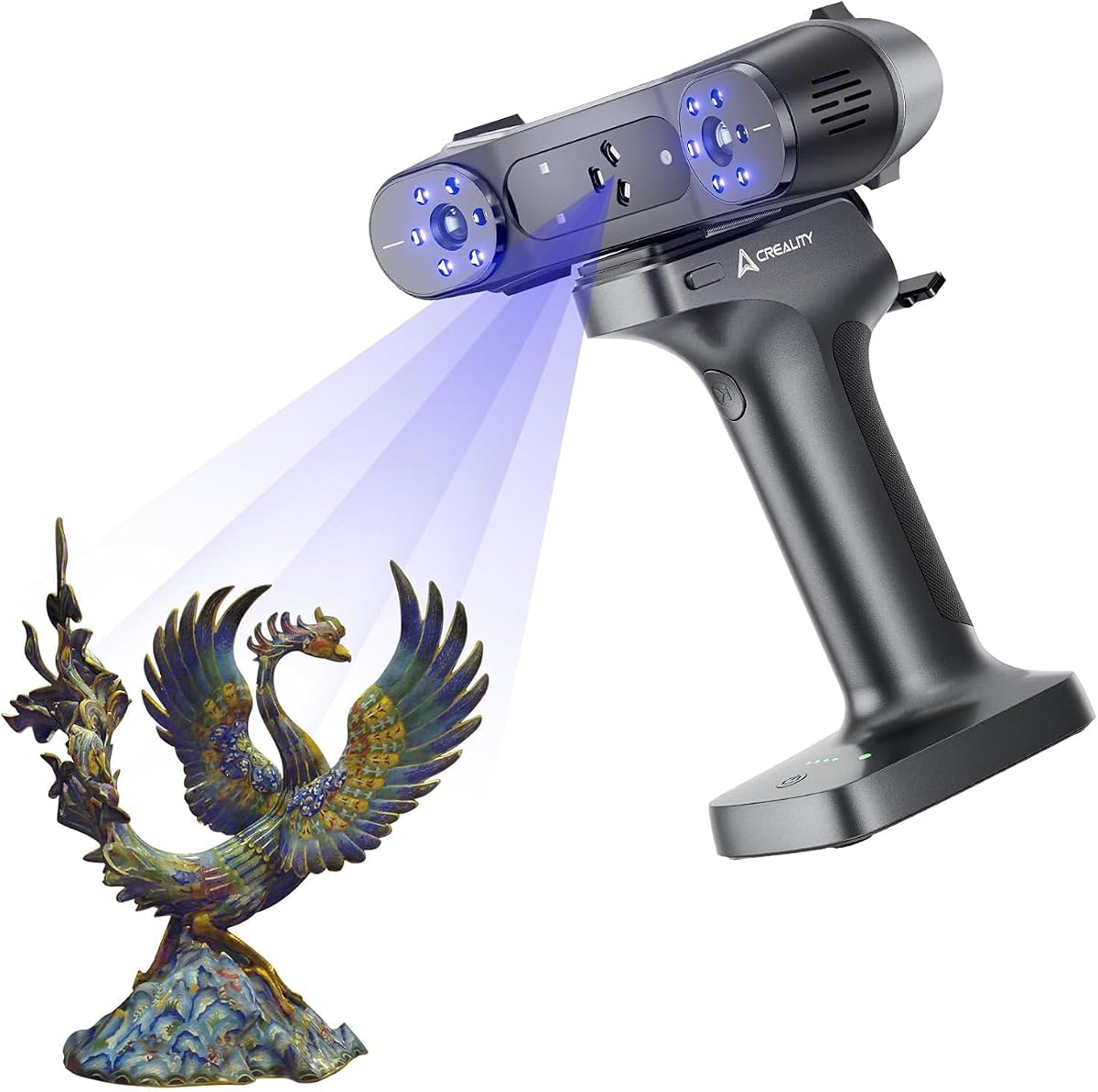
The Creality CR-Scan Raptor Pro delivers impressive versatility with the capability to scan objects ranging from tiny 5mm components to massive 4000mm items. It features 22 crossed blue lasers and seven parallel lines to capture intricate details at up to 660,000 dots per second making it ideal for automotive modification and industrial design.
We may earn a commission when you buy through this link, at no additional cost to you.
Its all-weather performance includes a temperature compensation algorithm ensuring stability in varying environmental conditions. The scanner captures true 24-bit full-color textures using a built-in RGB camera which restores realistic surface information essential for digital archiving and product visualization projects requiring accurate visual data.
Operating this scanner efficiently requires a robust computer setup often demanding high RAM and GPU specifications for smooth processing of large datasets. The handheld unit is also relatively heavy which might impact endurance during long sessions especially when scanning large objects that require multiple passes or detailed coverage.
Engineers seeking a scanner that can handle diverse project scales without switching devices will value the Raptor Pro's adaptability. It serves well for prototyping and reverse engineering where accurate color and geometry are both necessary for final design validation and manufacturing preparation.
Scans objects from 5x5x5mm to 4000x4000x4000mm covering everything from tiny mechanical parts to full car bodies in one system.
Temperature compensation algorithms maintain consistent scan quality even in high or low temperature environments for reliable industrial use.
We may earn a commission when you buy through this link, at no additional cost to you.
The Revopoint INSPIRE 2 offers an accessible entry point for reverse engineering tasks with a lightweight 190g design that enhances portability. It captures models with up to 0.05 mm accuracy and features outdoor scanning capabilities to handle lighting up to 20,000 lux ensuring reliable performance in various conditions.
We may earn a commission when you buy through this link, at no additional cost to you.
A notable feature is its adjustable optical zoom ranging from 1.5x to 2x magnification which helps focus projected light to capture mixed-geometry surfaces effectively. The dual scanning modules combine infrared structured light and multi-line laser to boost efficiency when dealing with different materials and sizes during field inspection workflows.
While it excels in portability the lower precision compared to industrial models might not suit tight tolerance requirements. Some reflective surfaces may still require scanning spray to ensure data capture which adds a minor prep step that users should anticipate for consistent results.
This scanner is perfect for educational settings prototyping workshops and field inspections where mobility and cost efficiency are paramount. Its user-friendly software and streaming capabilities allow quick data transfer for those needing fast results without high-end metrology precision levels.
Operates reliably in shaded or semi-bright conditions up to 20,000 lux allowing flexible scanning in diverse environmental lighting.
Optical zoom features let you focus light to capture detailed surface information on mixed-geometry parts without moving closer.
We may earn a commission when you buy through this link, at no additional cost to you.
The Creality Otter Lite Basic is designed for portability and ease of use with a plug-and-play setup ideal for DIY enthusiasts and entry-level reverse engineering. Weighing only 235g it supports both close-range and long-range scanning modes allowing fine details on small objects to be captured with 0.05mm precision.
We may earn a commission when you buy through this link, at no additional cost to you.
It features RGB and infrared cameras to capture true-to-life color textures at up to 30 fps ensuring exported models look realistic. The package includes essential accessories like a turntable calibration board and markers so users can start scanning immediately without needing additional purchases or complex assembly steps.
Users should note the scanner has a limited scanning range compared to industrial models which restricts the size of objects it can measure effectively. The software while user-friendly may lack advanced editing features found in professional suites limiting complex post-processing options for sophisticated engineering workflows.
For hobbyists or small studios needing a lightweight solution for simple part scanning this kit provides excellent value and convenience. It serves well for prototyping quick inspections where basic geometry and texture are sufficient for iterative design changes and 3D printing preparation.
Supports close-range 100–200mm and long-range 250–1500mm scanning modes to capture different object sizes with one device.
Includes turntable markers calibration board and case providing everything needed for on-the-go scanning right out of the box.
We may earn a commission when you buy through this link, at no additional cost to you.
The Revopoint MetroX Pro Standard delivers consistent industrial performance with single-frame precision up to 0.01 mm and a 62-line full-field blue structured light for marker-free scanning. It offers three tracking modes that adapt to object complexity ensuring stable captures for feature-rich or flat surfaces across various inspection scenarios.
We may earn a commission when you buy through this link, at no additional cost to you.
Integrated auto turntable functionality simplifies the scanning of complex objects with one-click automation. This reduces manual handling and improves workflow efficiency allowing operators to focus on data verification rather than device positioning during repetitive quality control tasks.
While it shares many features with advanced models it lacks wireless connectivity options which can limit flexibility in large or multi-device setups. The reliance on Windows-only software also constrains its deployment in cross-platform environments where Mac or Linux support might be necessary for some teams.
This scanner is an excellent choice for production environments where reliability and precision are more critical than portability. It ensures robust data capture for reverse engineering projects requiring consistent results over long periods without the risk of connection interruptions.
Offers feature marker and global marker tracking modes to adapt accuracy based on object shape and surface detail requirements.
Dual-axis turntable automates 3D scanning of complex objects with one click for streamlined and repeatable capture processes.
We may earn a commission when you buy through this link, at no additional cost to you.
The Creality CR-Scan Raptor Pro features robust wireless outdoor readiness allowing high-precision scanning in environments without lab constraints. Its 22 crossed laser lines withstand up to 100,000 lux enabling reliable data capture even under harsh sunlight which is critical for outdoor industrial inspections and automotive work.
We may earn a commission when you buy through this link, at no additional cost to you.
This model integrates CrealityScan app designed for ease of use with step-by-step tutorials and advanced editing tools. It supports face and body modes allowing full-body scans in as little as two minutes providing versatile applications beyond standard mechanical part reverse engineering needs.
Battery management is key for outdoor use as long sessions may require frequent recharging to maintain consistent performance. The initial setup and calibration process can be slightly complex for new users requiring time to fully utilize the advanced software features effectively.
For mobile engineering teams or field inspectors who need immediate wireless operation this scanner offers a practical balance of performance and convenience. It is particularly suited for large object scanning where traditional wired connections would limit reach and flexibility significantly.
Works flawlessly outdoors with laser modes handling up to 100,000 lux for reliable performance under harsh sunlight conditions.
Unique face mapping algorithm captures detailed human body scans in about two minutes for medical or digital avatar applications.
We may earn a commission when you buy through this link, at no additional cost to you.
The Creality Raptor X boasts 34 cross blue laser lines that enable rapid scanning of medium to large objects with single-frame accuracy up to 0.02mm. Its large capacity 35400mWh battery supports extended outdoor use while fast charging ensures minimal downtime between inspection sessions.
We may earn a commission when you buy through this link, at no additional cost to you.
It features lossless data compression over Wi-Fi 6 allowing quick and easy transfer of scans to computers without latency. The speckle matching 3D imaging technology supports markerless scanning for feature-rich workpieces making setup faster and workflow smoother during complex part documentation.
The scanner's robust battery and hardware contribute to a heavier unit which might require ergonomic considerations during prolonged handheld use. Its advanced features come at a premium cost that could be a barrier for smaller firms not requiring such high-speed large-format capture capabilities.
Professionals working on automotive or engineering parts will benefit from the Raptor X's speed and wireless efficiency in field scenarios. It ensures rapid and accurate capture of large assemblies reducing overall project timelines while maintaining high fidelity for precise reverse engineering.
34 cross blue laser lines enable rapid and effortless capture of complete accurate 3D data from medium to large objects quickly.
Advanced lossless data compression allows scans to be transferred quickly and easily over Wi-Fi 6 from scanner to computer.
We may earn a commission when you buy through this link, at no additional cost to you.
The Creality Raptor Pro achieves metrology-grade accuracy up to 0.02mm with advanced blue laser technology and scan speeds of 660,000 points/s. It combines blue lines with infrared structured light to scan a wide range of objects seamlessly from tiny components to large automotive parts.
We may earn a commission when you buy through this link, at no additional cost to you.
Professional software integration offers multi-project stitching and real-time preview for seamless 360° scans and post-processing. Wireless support allows flexible positioning and operation which is vital for complex inspection tasks where physical connections might restrict movement or access to tight spaces.
This model requires powerful computer hardware for optimal performance which may necessitate upgrades for existing workstations. The learning curve for advanced settings can be steep initially requiring users to invest time in mastering the software for best results.
Engineers needing high-precision metrology data without specialized lab equipment will find the Raptor Pro a versatile and powerful tool. It delivers reliable results for reverse engineering and quality control tasks requiring strict adherence to dimensional tolerances and detailed surface analysis.
Achieves accuracy up to 0.02mm with advanced blue laser technology ensuring reliable industrial inspection and reverse engineering data.
Combines blue laser lines with infrared structured light to scan various materials from tiny components to large automotive parts.
We may earn a commission when you buy through this link, at no additional cost to you.
Selecting the right 3D scanner requires balancing precision speed and compatibility with your specific engineering workflow.
Accuracy determines how closely the scanned model matches the original object while precision ensures consistent repeatability. For reverse engineering tasks metrology-grade accuracy typically around 0.02mm or better is essential to ensure parts fit and function as intended.
Prioritize scanners with verified volumetric accuracy specs that align with your tolerance requirements for manufacturing or quality control workflows.
Higher scanning speeds like 60 FPS or more allow faster data capture for large or complex assemblies reducing project time. Resolution dictates the smallest detail the scanner can capture affecting the quality of the resulting point cloud or mesh.
Choose a scanner with frame rates and resolution that support your typical object sizes and detail levels without compromising workflow efficiency.
Scanners must handle challenging surfaces such as shiny dark or textured materials without requiring spray. Technologies like blue lasers or infrared structured light often perform better on difficult surfaces than standard white light options.
Ensure your scanner supports spray-free operation to avoid contamination and save prep time especially when working with delicate parts or prototypes.
The software ecosystem is critical for converting scans into usable CAD models or meshes. Check if the scanner supports export formats like STL OBJ or PLY and integrates with your preferred design tools.
Opt for devices with intuitive interfaces and plugins for CAD software to streamline the transition from raw data to engineering-ready models.
Wireless connectivity via Wi-Fi or Bluetooth allows greater freedom when scanning large objects or working in the field. Portable lightweight designs reduce fatigue during long sessions and enable mobile inspections at various locations.
Evaluate battery life and cable requirements to ensure the scanner fits your operational environment whether fixed in a lab or deployed on-site.
If you scan outdoors or in harsh conditions look for models with temperature compensation and high lux resistance to maintain performance. Dust and moisture resistance ratings are also important for industrial settings with variable conditions.
Invest in scanners with built-in environmental protections to ensure consistent data quality regardless of ambient light or temperature fluctuations.
Reliable customer support and warranty terms are vital for professional users who depend on uninterrupted scanning operations. Regular firmware updates and accessible calibration tools help maintain accuracy over the device's lifespan.
Select brands with active communities and responsive service teams to resolve technical issues quickly and keep your workflow running smoothly.
Balance the upfront cost against the scanner's features and longevity to find the best long-term value. Entry-level models may suffice for prototyping while industrial-grade devices justify higher prices through superior accuracy and durability.
Consider total cost of ownership including necessary accessories and software subscriptions to avoid unexpected expenses after purchase.
Begin by calibrating your scanner using the provided board to ensure accurate measurements before each session. Proper calibration aligns internal sensors and maintains the specified precision levels critical for reverse engineering tasks.
Clean lenses and sensors regularly with soft lint-free cloths to prevent dust or smudges from affecting scan quality. Store the device in a protective case when not in use to safeguard sensitive components from physical damage or environmental exposure.
Update firmware and software regularly to benefit from performance improvements and new features. Regularly backup your scan data to external drives or cloud storage to prevent loss and maintain a history of your engineering projects.
A suitable scanner combines high accuracy typically below 0.05mm with robust software for point cloud processing. It must handle various surface types without spray and support CAD export formats to streamline the transition from physical part to digital model.
Yes many modern scanners use blue lasers or infrared structured light to capture reflective and dark surfaces effectively. Some models require temporary sprays but advanced units can process these materials directly without extra prep steps.
Most scanners include basic acquisition software but advanced reverse engineering tools may require separate licenses. Check if the package offers CAD integration plugins to ensure seamless workflow between scanning and design software.
Many industrial-grade scanners support outdoor use with sunlight resistance and wide working ranges. Look for models with high lux tolerance to maintain accuracy even under bright natural light conditions in the field.
Use the included calibration board to align sensors and verify precision before scanning. Follow manufacturer instructions to run calibration routines that adjust internal parameters for optimal accuracy during data capture.
High-performance CPUs and dedicated GPUs are recommended to handle large point clouds and mesh processing. Aim for at least 16GB RAM and modern graphics cards to avoid lag during real-time scanning or post-processing.
The Revopoint MetroX Pro EinScan Rigil and Revopoint INSPIRE 2 lead our picks offering distinct advantages for precision speed and budget-conscious users. Each model delivers reliable performance tailored to different engineering needs ensuring you find a scanner that fits your workflow.
Prioritize accuracy surface adaptability and software compatibility when selecting a scanner to ensure smooth transitions from physical objects to CAD models. Investing in the right technology now will streamline reverse engineering tasks and improve design accuracy across your projects.
Always verify current pricing and availability before purchase as models and offers change regularly. Use this guide to compare specs and features confidently choosing a solution that meets your specific reverse engineering requirements.