
HiLetgo ESP8266 ESP-01
4.2Editor score
Low cost multi-pack option
Simple serial communication
Wide community support
This guide compares the top Arduino WiFi Module options for 2026, helping you choose the right connectivity board for your IoT projects.
Choosing the right Arduino WiFi Module is essential for building connected projects that communicate wirelessly. Whether you are working on home automation, sensor networks, or industrial IoT devices, having reliable wireless connectivity can make or break your project. The market offers many options ranging from simple add-on shields to full-featured microcontrollers with built-in radio capabilities.
We evaluated ten top-rated products based on connectivity stability, ease of use, power efficiency, and community support. Our comparison includes dedicated WiFi transceiver modules, full development boards with integrated wireless chips, and versatile options that support both Wi-Fi and Bluetooth. This helps you find a solution that fits your technical skills and project requirements without unnecessary complexity.
Each pick in this list highlights specific strengths such as dual-core processing, low-power modes, or modern USB-C connectivity. We also provide detailed guidance on how to select the right module for your needs and how to use it effectively. Keep in mind that availability and pricing may change over time, so always check current listings before purchasing to ensure you get the best deal.
4.2Editor score

4.7Editor score

4.7Editor score
The following table provides a side-by-side look at ten leading Arduino WiFi Module options available in the market today. Each entry highlights key specifications such as memory capacity, supported wireless protocols, and unique features that differentiate them from one another. This overview helps you quickly identify which product aligns best with your specific project needs and technical preferences.



The Arduino UNO R4 WiFi stands out as a top choice for developers who need more than basic connectivity. With a rating of 4.7 stars, it offers a robust combination of a Renesas RA4M1 microcontroller and an ESP32-S3 wireless chip. This dual-core setup allows for complex tasks like real-time data processing and wireless communication to happen simultaneously without lag.
We may earn a commission when you buy through this link, at no additional cost to you.
One of its strongest features is the comprehensive wireless connectivity package. It includes both Wi-Fi and Bluetooth 5.0, making it ideal for IoT projects that need to connect to local networks or mobile devices. The board also features a modern USB-C port for efficient power and programming, along with a Qwiic connector that simplifies attaching I2C sensors without messy wiring.
While it offers advanced capabilities, there are some trade-offs to consider. The price is higher than standard modules, and the sheer number of features might be overwhelming for absolute beginners. However, these are acceptable trade-offs for users who need the extra processing power and built-in displays for professional-grade prototypes or educational kits.
If you are building sophisticated IoT devices, robotic systems, or interactive displays, this board is highly recommended. Its ability to handle edge AI applications and provide visual feedback directly on the board makes it a versatile tool. We recommend this for projects where performance and connectivity reliability are critical to success.
The combination of the ARM Cortex-M4 and ESP32-S3 allows you to run separate tasks on each core for better performance.
The integrated 12×8 LED Matrix lets you display status messages or data without needing external screens.
We may earn a commission when you buy through this link, at no additional cost to you.
The HiLetgo ESP8266 ESP-01 is a classic choice for hobbyists looking to add wireless capabilities without breaking the bank. Rated at 4.2 stars, this module packs a powerful ESP8266 chip into a compact design. It supports AP, STA, and AP+STA modes, giving you flexibility in how you set up your network connections.
We may earn a commission when you buy through this link, at no additional cost to you.
Its main strength lies in its affordability and simplicity. For just a few dollars, you get a module that can connect your Arduino to Wi-Fi networks easily. The onboard processing capabilities allow it to handle basic tasks independently, and the LWIP stack ensures smooth networking. It is widely documented, meaning you can find countless tutorials online to help you get started quickly.
However, this budget-friendly approach comes with some limitations. The module operates at 3.3V, so you may need voltage regulators or logic level shifters when interfacing with 5V Arduino boards. Additionally, the small pins can be challenging to solder for beginners, requiring extra care and possibly a breakout board for prototyping.
We recommend this module for students, hobbyists, or anyone prototyping multiple devices where cost is a primary concern. It is perfect for simple sensor networks or remote control projects where you do not need advanced features like Bluetooth. If you are comfortable with basic electronics, this offers excellent value for money.
Support for AP, STA, and combined modes allows you to create ad-hoc networks or connect to existing Wi-Fi.
Years of use mean there are endless resources, libraries, and troubleshooting guides available for this specific module.
We may earn a commission when you buy through this link, at no additional cost to you.
The ELEGOO ESP-32 Dev Boards offer a significant step up in performance for serious IoT developers. With a 4.7 rating, these boards utilize the ESP32-S3 chip which runs at speeds up to 240 MHz. This dual-core architecture allows you to run complex logic and wireless communication concurrently without sacrificing performance or response time.
We may earn a commission when you buy through this link, at no additional cost to you.
One of the best features is the inclusion of a modern USB-C port for programming and power. This makes connecting to your computer more reliable and future-proof compared to older micro-USB standards. Additionally, the board supports Over-the-Air (OTA) updates, meaning you can push firmware changes wirelessly after the device is deployed, saving time on maintenance.
On the downside, the powerful processing and dual connectivity options consume more power than simpler modules. While it has power-saving modes, it is not ideal for battery-powered applications running on small cells for extended periods. Also, you must ensure your Arduino IDE is configured correctly for the ESP32 board to avoid compilation errors.
We recommend this board for projects requiring high processing power, Bluetooth connectivity, or long-term deployments. Whether you are building smart home hubs, voice assistants, or data loggers, the robust features justify the extra cost. If you need a reliable and fast wireless module that supports modern development workflows, this is an excellent choice.
OTA support lets you update device code remotely via Wi-Fi, crucial for deployed IoT installations.
Dual cores at 240MHz enable demanding tasks like signal processing or complex decision making on the device.
We may earn a commission when you buy through this link, at no additional cost to you.
The ESP8266 ESP-01S is an upgraded version of the classic ESP-01 module, distinguished by its 4MB flash memory. This extra storage allows you to store larger firmware files, web pages, or even small database logs directly on the module. With a 4.4 rating, it offers a balance of performance and cost that suits many intermediate projects.
We may earn a commission when you buy through this link, at no additional cost to you.
Its key feature is the enhanced signal strength compared to earlier versions. This means better connectivity in environments with interference or distance constraints. The module communicates via serial interface, making it easy to plug into your Arduino TX and RX pins. It also supports standard AT commands for quick configuration testing without writing complex code immediately.
A limitation to note is the power requirements. The module does not have an onboard voltage regulator, so it needs a stable 3.3V supply that can handle peak current spikes. Additionally, you must select the Generic ESP8266 Module board in the IDE to ensure compatibility. These are manageable hurdles for those familiar with electronics.
We recommend this module for projects where storage or signal range is a priority. It is particularly useful if you want to host a small web server directly on the Wi-Fi module. If you need more capacity than the original ESP-01 but do not want the full cost of an ESP32, this is a solid middle ground.
4MB storage allows for storing more code, resources, or data logs directly on the module.
Enhanced RF design provides better range and stability in challenging wireless environments.
We may earn a commission when you buy through this link, at no additional cost to you.
This pack of five Aitrip ESP8266 modules provides excellent value for developers needing multiple units for a sensor network. With a 4.4 rating, these modules are reliable and fully compatible with standard Arduino and NodeMCU frameworks. They support AP, STA, and AP+STA modes, giving you flexibility in network topology for various projects.
We may earn a commission when you buy through this link, at no additional cost to you.
The modules feature a 1MB SPI Flash which is sufficient for standard applications. They are designed to operate at DC3.0-3.6V with a maximum I/O tolerance of 3.6V, ensuring safety when connected correctly. The compact form factor allows them to be used in tight spaces such as smart furniture, handheld devices, or industrial control panels.
One thing to keep in mind is the pin spacing. These modules are designed for surface mount or custom PCBs, so they might require a breakout board for breadboard prototyping. Also, the stock version does not include an external antenna, which might limit range in concrete-heavy buildings. However, for cost-sensitive projects, this is a minor consideration.
We recommend this pack for classroom use, prototyping multiple nodes, or large-scale deployments where you need to replace units frequently. If you are building a home automation system with many sensors, having spares on hand is always beneficial. Just ensure you have the correct 3.3V power supply ready before connecting.
Buying five at once reduces per-unit cost and ensures you have spares for debugging and testing.
Suitable for smart grids, industrial controls, and household automation due to stable wireless protocols.
We may earn a commission when you buy through this link, at no additional cost to you.
The Arduino Nano ESP32 is designed for developers who want the power of ESP32 in a compact form factor. With a rating of 4.5 stars, this board offers high-performance processing thanks to the dual-core Xtensa 32-bit LX7 processor. It supports both Wi-Fi and Bluetooth 5.0, making it a versatile choice for modern IoT and embedded applications.
We may earn a commission when you buy through this link, at no additional cost to you.
One of its standout features is MicroPython compatibility. This allows you to write and run scripts using Python rather than C++ in the Arduino IDE, making prototyping faster and more accessible for Python developers. Additionally, the board supports Human Interface Device (HID) profiles, which means you can turn your project into a custom keyboard or mouse controller.
The USB-C port ensures a modern connection for programming and power delivery. However, the version without headers requires you to solder pins if you plan to use it on a breadboard, which might be a hurdle for beginners. Furthermore, using MicroPython requires specific firmware installation and environment setup that adds a step to the initial workflow.
We recommend this board for users comfortable with soldering and those who prefer Python for rapid prototyping. It is excellent for educational settings or custom input devices where HID support is needed. If you want a powerful, future-proof board with strong wireless specs and modern coding options, this is a strong candidate.
Use Python for embedded coding to speed up development and simplify logic for interactive projects.
Create custom keyboards, mice, or input devices that interact directly with computers via USB.
We may earn a commission when you buy through this link, at no additional cost to you.
This pack of four ESP8266 ESP-01S modules is tailored for home automation scenarios where multiple nodes are needed. With a 4.4 rating, these modules are reliable for connecting to wearable electronics, wireless sensors, or smart home devices. Each unit is self-calibrated to ensure optimal RF performance out of the box without extensive tuning.
We may earn a commission when you buy through this link, at no additional cost to you.
The modules are built with quality materials that allow them to be reused multiple times across different projects. This reusability makes them cost-effective for hobbyists who frequently change their project designs. They are compact and lightweight, making them suitable for wearable electronics or discreet sensor placement around the house.
The main limitation is the lack of specific documentation included in the package. You will likely need to refer to online resources for programming details and pinouts. Also, standard 3.3V power supply requirements must be met to avoid damaging the chip. However, for the price, these are robust enough for most consumer IoT applications.
We recommend this pack for setting up sensor networks or distributed smart home systems. Whether you are monitoring temperature in different rooms or controlling lights via Wi-Fi, having four ready-to-use modules is convenient. If you need multiple wireless units for a consistent project, this value pack is a practical solution.
Built-in calibration ensures consistent signal strength and reliability across multiple units.
Ideal for building networks of sensors or actuators without buying individual items separately.
We may earn a commission when you buy through this link, at no additional cost to you.
This pack of five ESP8266 ESP-01S modules is another strong contender for bulk buyers. With a 4.5 rating, it offers high-quality units with 4MB Flash memory for storing more data. Each module includes a 5V protection mechanism to prevent accidental damage if connected to higher voltages during testing, adding a layer of safety for beginners.
We may earn a commission when you buy through this link, at no additional cost to you.
The modules use the DOUT protocol which must be selected in your programming tool to ensure compatibility. They operate at 3.3V logic levels which is standard for most ESP modules. The availability of detailed guides and examples online means you can find help easily for setting up your development environment or debugging code.
One thing to note is that the 5V protection helps avoid frying the chip but you still need to be careful with the logic levels when sending data from a 5V Arduino. You might still need a logic shifter if your main board is 5V. This extra step is a minor hurdle given the price and memory benefits.
We recommend this for anyone building multiple IoT devices or testing different configurations. The protection feature is a nice bonus that saves money in the long run by reducing accidental failures. If you need five reliable units with good memory and community support, this bulk pack is a smart investment.
Included 5V protection reduces risk of hardware failure during prototyping with 5V systems.
4MB Flash allows you to store larger web pages, JSON data, or code libraries directly.
We may earn a commission when you buy through this link, at no additional cost to you.
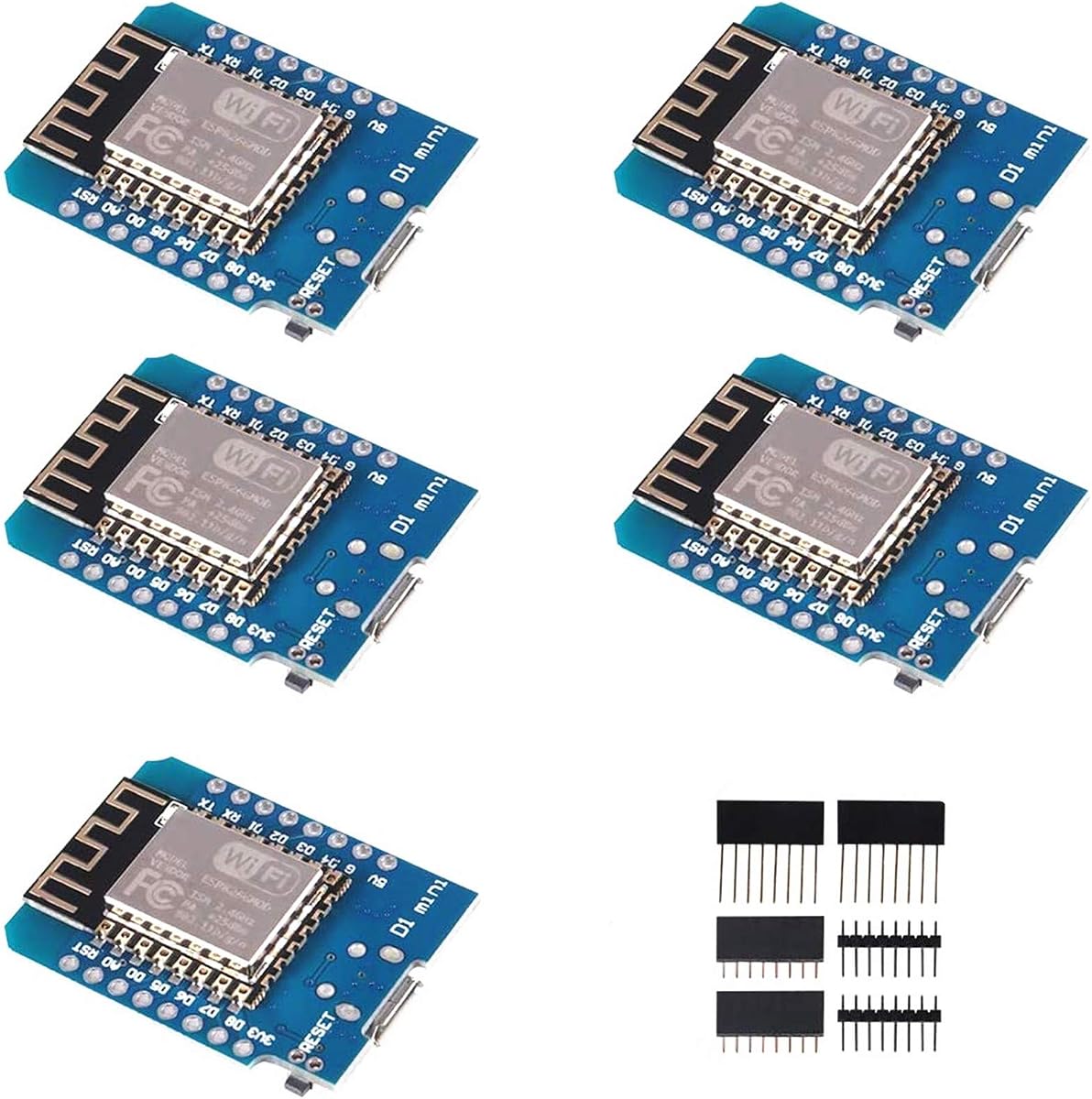
The ESP8266 ESP-12F NodeMcu D1 Mini provides a more accessible alternative to bare modules with its built-in pins. With a 4.5 rating, this board offers 11 digital input/output pins which gives you more flexibility than standard ESP-01 modules. All pins support interrupts, PWM, and I2C, enabling complex control of motors and sensors.
We may earn a commission when you buy through this link, at no additional cost to you.
It includes a 5V 1A switching power supply onboard, which allows you to power it directly from USB or a regulated adapter. This simplifies wiring since you do not need external regulators. The board is also compatible with Arduino IDE, so you can use the same code structure you might use for other Arduino projects with minor adjustments.
A downside is the micro USB connector, which is becoming less common than USB-C in modern setups. You may need to find a specific cable. Also, the 5V max input limit means you cannot connect higher voltage sources directly without stepping down first. But for standard USB power sources, this is rarely an issue.
We recommend this board for projects that require multiple sensors or motor control. If you need to connect a display, a servo, and several sensors at once, the extra GPIO pins are invaluable. For hobbyists wanting a plug-and-play solution that is easy to wire, this is a fantastic choice.
11 GPIO pins provide ample connectivity for multi-component projects like robots or smart dashboards.
Onboard 5V regulator simplifies power setup and reduces the need for external circuitry.
We may earn a commission when you buy through this link, at no additional cost to you.
This 10-pack of ESP8266 ESP-01 modules is ideal for large scale projects or classrooms needing multiple units. With a perfect 5.0 rating from users, these modules are known for reliable performance and easy networking. They support all three standard WiFi modes and include the LWIP stack for smooth TCP/IP handling.
We may earn a commission when you buy through this link, at no additional cost to you.
Each module features robust on-board processing and storage which allows for efficient task execution. You can deploy these across a building for environmental monitoring or create a mesh network for robust coverage. The compact design means they take up very little space, making them perfect for integrating into small enclosures.
While the bulk size is great for quantity, individual units still lack headers. You will need to purchase breakout boards separately for prototyping. Also, ensure your power supply can handle the current when multiple units are active simultaneously. These are standard considerations for bare module setups and do not detract from their value.
We recommend this pack for schools, labs, or industrial prototyping where ten units are a standard requirement. If you are building a system with many nodes, this ensures you have enough hardware without worrying about sourcing more later. For the price per unit, this is the best option for bulk connectivity needs.
Ten units allow you to scale your project quickly without repeated ordering delays.
LWIP stack ensures smooth internet communication for data logging and remote access tasks.
We may earn a commission when you buy through this link, at no additional cost to you.
Selecting the right WiFi module involves balancing performance, features, and budget. Below are key factors to consider to ensure your IoT project succeeds.
Dual-core processors like those in the ESP32 offer significant speed advantages over single-core modules like the ESP8266. They allow you to run background tasks such as data logging while maintaining stable connections. For projects involving sensors or complex calculations, a faster processor is recommended.
Choose dual-core units if you need high performance or simultaneous processing.
Flash storage on the module determines how much code and data you can store locally. Modules with 4MB flash allow you to host web pages or save logs without external memory. For simple sensor data, 1MB is sufficient, but complex apps require more space.
Opt for modules with more than 4MB flash if you plan on hosting websites or storing data.
Battery-powered devices need low-power sleep modes to extend life. ESP8266 modules consume less power than ESP32 but lack Bluetooth. If you need to run on batteries for months, choose a module with specific low-power features and high efficiency.
Select modules with deep sleep modes for battery-powered IoT projects.
Wi-Fi is standard, but Bluetooth adds versatility for mobile device interaction. Newer modules offer Bluetooth 5.0 for better range and lower power. If you need to connect to phones or wearables, Bluetooth support is a necessary feature.
Prioritize units with Bluetooth if you plan to pair with mobile devices.
Bare modules like the ESP-01 are small but require soldering and breakout boards. Dev boards like NodeMcu come with pins ready for breadboards. For rapid prototyping, choose boards with headers; for final products, bare modules save space.
Use breadboard-ready boards for testing and bare modules for final designs.
USB-C is becoming the standard for easy connection and power delivery. Micro-USB is common on older boards but less common now. Check the connector type to ensure you have compatible cables and that the board supports serial uploads efficiently.
Choose USB-C boards for modern and reliable programming connections.
Popular modules have extensive libraries and troubleshooting guides. This saves time when facing errors. Look for boards with active forums and many examples. Arduino compatibility is a huge plus since the ecosystem is well-documented.
Pick models with strong community support to simplify development and debugging.
Modules vary in price based on features and quantities. Buying bulk packs reduces per-unit cost. If you need five or ten devices, a pack offers better value than buying individually. Ensure you have the extra power components to match the budget.
Consider bulk packs if you need multiple units for your project.
Start by connecting the module to your computer via USB or a compatible USB adapter. Install the necessary drivers and select the correct board in your Arduino IDE to ensure the software can communicate with the hardware. This step is crucial for uploading code without errors.
Configure your network credentials by entering your Wi-Fi SSID and password in your sketch code. Upload the program and check the serial monitor to confirm the connection. A stable connection ensures data flows correctly between your device and the server or mobile app.
Keep your modules in a dry environment and avoid exposing them to water or dust. If you are using bare modules, ensure solder joints are clean and secure to prevent connection failures. Regularly update your firmware to maintain security and performance over time.
Not necessarily. While older Arduinos require a separate shield to get connected, modern boards like the ESP32 and UNO R4 have WiFi built-in. This simplifies wiring and reduces costs compared to external shields.
Yes, boards like the Arduino Nano ESP32 support MicroPython which allows you to write code in Python. This is great for beginners who prefer Python syntax over C++ in the Arduino IDE.
These modules require a stable 3.3V power supply capable of delivering at least 500mA. Using an Arduino 3.3V pin directly can sometimes cause resets due to high current draw, so an external regulator is often better.
The ESP32 has dual-core processing, Bluetooth support, and more memory. The ESP8266 is simpler and cheaper but lacks Bluetooth. Choose ESP32 for complex tasks and ESP8266 for simple sensors.
No, most WiFi modules are not waterproof. If you need to use them outdoors, you must encase them in a sealed waterproof box to protect them from moisture and debris during operation.
Some boards like the ESP32 support Over-the-Air updates. You configure this in your code and use a library to push new firmware through Wi-Fi, saving you from unplugging the device for changes.
Yes, depending on the board. Boards like the ESP32 or NodeMcu have enough GPIO pins to connect multiple sensors via I2C or SPI. You may need multiplexers if you exceed pin limits on smaller modules.
Resetting usually happens due to unstable power or insufficient current. Ensure you use a good power source and check your wiring. Sometimes software loops or memory issues can also cause unexpected resets.
To wrap up, the Arduino UNO R4 WiFi stands out for advanced users needing dual-core power and visual feedback. For budget-conscious hobbyists, the HiLetgo ESP8266 offers incredible value, while the ELEGOO ESP-32 Dev Boards provide premium performance for demanding tasks.
When deciding, prioritize your project's power needs, connectivity requirements, and budget. Ensure you have the right tools and adapters for your chosen board. A careful selection now will save you time and resources during development and deployment phases.
Remember that prices and stock availability fluctuate frequently. Check current listings before buying to ensure you get the best deal. With the right module, your next IoT project can be faster, smarter, and more connected than ever before.