As an Amazon Associate we earn from qualifying purchases. We may earn a commission when you buy through links on this page, at no additional cost to you. Read our affiliate disclosure.As an Amazon Associate we earn from qualifying purchases.Purchases through our links may earn us a commission, at no extra cost to you. Read our affiliate disclosure.
Choosing the right Arduino Temperature Sensor is essential for any project involving environmental monitoring or climate control. A good sensor provides accurate readings across wide ranges while remaining easy to integrate with your microcontroller. Whether you need humidity data or waterproof capabilities, selecting the correct model ensures reliability and longevity in your application.
We have evaluated ten popular sensor modules based on accuracy, communication protocols, voltage requirements, and user feedback. Our comparison focuses on real-world performance metrics and compatibility with standard Arduino boards. This list covers both budget-friendly options and high-precision industrial-grade sensors to meet diverse project needs.
Each pick below highlights specific strengths such as waterproofing, digital output, or wide voltage support. You will find detailed specifications and pros and cons for every item on this list. Please note that prices and availability change frequently so verify current details before making your final purchase decision.
Top 3 Picks for Best Arduino Temperature Sensor
Best Budget
HiLetgo 5pcs DHT11 Temperature Humidity Sensor Module Digital Temperature Humidity Sensor 3.3V-5V Humidity Measure Range 20%-95% Temperature Measure Range 0-50℃ Celsius with Wires
DROK 2 Pack Waterproof DS18B20 Temperature Sensor Probes with 2 Pack Probe Adapter Boards, Female to Female Jumper Wires and 4.7K ohm Resistors for Arduino Raspberry Pi DIY
Top 10 Best Arduino Temperature Sensor in 2026 Compared
The following table offers a side-by-side look at all ten selected temperature sensor modules. It highlights key specifications and communication types to help you quickly identify which model fits your specific project requirements.
This module offers exceptional accuracy with a ±0.3°C rating making it ideal for precision applications. The wide voltage range allows compatibility with various Arduino boards without additional regulators.
Pros
High precision readings
Wide voltage support
Three units included
Fast I2C communication
Cons
Slightly higher cost
Requires I2C library
We may earn a commission when you buy through this link, at no additional cost to you.
The I2C interface ensures fast and reliable data transmission over longer distances compared to single-wire options. Users report stable performance even in fluctuating electrical environments.
While the price point is higher than basic DHT models the precision and robust design justify the cost for critical projects. The included three-pack ensures you have spares for larger setups.
Choose this sensor if accuracy is your top priority and you need reliable long-term stability. It is perfect for weather stations or climate control systems requiring precise thresholds.
Superior Temperature Accuracy
The SHT31-D delivers industry-leading precision suitable for scientific or industrial monitoring tasks.
Versatile Power Requirements
Operating between 2.4V and 5.5V simplifies integration with both 3.3V and 5V logic systems.
This classic sensor remains a top choice for beginners due to its low cost and ease of use. The simple single-wire protocol makes coding straightforward for new Arduino users.
Pros
Very affordable price
Simple wiring setup
Five sensors per pack
Wide community support
Cons
Limited temperature range
Lower humidity accuracy
We may earn a commission when you buy through this link, at no additional cost to you.
With five units included you can equip multiple rooms or projects without breaking the budget. It performs well for general monitoring where extreme precision is not critical.
The trade-off is a narrower temperature range and lower accuracy compared to premium models. This limits its use in environments with extreme heat or high humidity requirements.
Buy this pack for educational projects or basic home automation where cost efficiency matters most. It is a reliable starting point for learning sensor integration.
Easy Single Wire Connection
The simple digital output reduces pin usage and simplifies circuit design for beginners.
Great for Learning
With extensive online tutorials this sensor is the go-to choice for DIY electronics education.
The stainless steel probe ensures durability in wet or corrosive environments where plastic sensors fail. The adapter board simplifies connection by including the necessary pull-up resistor.
Pros
Fully waterproof design
Includes adapter board
High accuracy rating
Complete wiring kit
Cons
Probe leads have limits
Requires 1-wire library
We may earn a commission when you buy through this link, at no additional cost to you.
Accuracy remains high across the wide temperature range making it suitable for industrial or outdoor monitoring. Users praise the complete kit that includes jumper wires and resistors.
The lead wires can withstand heat up to 85 degrees so avoid direct contact with extreme heat. For most applications this limitation is acceptable given the overall robustness.
Select this model for aquariums greenhouses or any project requiring direct water contact. It offers the best combination of durability and ease of integration.
Complete Integration Kit
Everything needed for setup including resistors and jumpers is included to speed up deployment.
Rugged Stainless Steel
The corrosion-resistant casing protects the sensor electronics from moisture and physical damage.
This sensor boasts a perfect five star rating from verified purchasers due to its reliable performance. The I2C interface allows multiple sensors on the same bus without pin conflicts.
Pros
Zero error rate feedback
I2C communication
Compact module size
Wide voltage range
Cons
Requires I2C pins
Limited to two units
We may earn a commission when you buy through this link, at no additional cost to you.
Users highlight the high resolution and fast transmission speeds as major advantages over older models. The compact design fits easily into small enclosures or wearable projects.
While the 85°C limit is lower than some industrial options it covers most consumer applications. The small size is ideal for projects with space constraints.
Choose this sensor for multi-sensor arrays where pin space is limited. It balances performance and size effectively for modern DIY projects.
Multi-Device Bus Support
I2C communication enables you to connect many sensors using only two data pins.
Fast Data Output
Stable transmission speed ensures real-time updates for dynamic monitoring tasks.
This set includes a one meter lead which allows you to place the sensor far from your Arduino. The adapter module removes the need for external resistors during setup.
Pros
Long measurement cable
Adapter simplifies wiring
Waterproof probe
Good value for 3
Cons
Leads limit temp
Some soldering needed
We may earn a commission when you buy through this link, at no additional cost to you.
The waterproof probe protects the sensor in wet environments like tanks or outdoor weather stations. Users appreciate the plug-and-play nature of the adapter board.
The lead wires have a lower heat tolerance which limits use in very hot industrial settings. For general monitoring this is rarely a significant issue.
Opt for this kit when you need to monitor remote areas away from your microcontroller. It saves time on wiring and ensures safe connections.
Flexible Sensor Placement
The one meter lead allows you to move the probe to hard to reach areas.
Easy Plug and Play
Built-in pull-up resistor on the adapter reduces external component requirements.
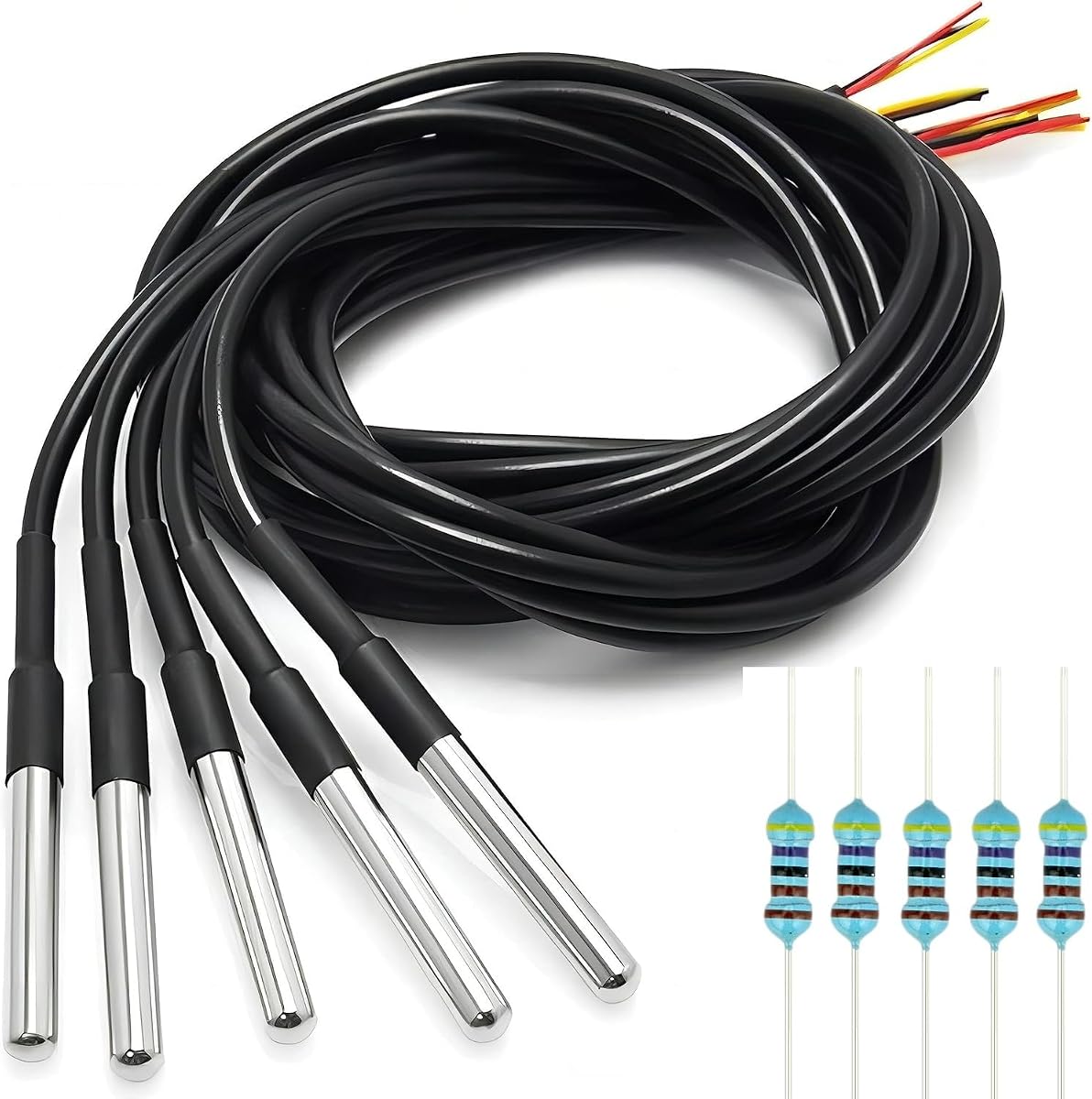
This bundle offers five waterproof probes with matching resistors making it a cost-effective solution for multi-zone monitoring. The DS18B20 provides reliable accuracy across a wide range.
Pros
Five units included
Resistors provided
Accurate readings
Waterproof design
Cons
Basic packaging
Long leads only
We may earn a commission when you buy through this link, at no additional cost to you.
Users find it easy to daisy chain multiple sensors to monitor different parts of a house or garden. The inclusion of resistors eliminates a common source of confusion for beginners.
The packaging is functional rather than premium but the sensor performance remains high. It is a practical choice for bulk purchases.
Buy this set if you need to monitor many locations at once. The value per unit is hard to beat for serious hobbyists.
Cost Effective Multi-Sensor
Five probes allow you to build a network of sensors for detailed environmental mapping.
Ready To Connect
Included resistors ensure you can connect directly without sourcing extra components.
This two-pack provides a basic but reliable option for those just starting with environmental sensors. The simple wiring and digital output make it easy to test quickly.
Pros
Low cost
Easy to code
Wires included
Reliable for hobby
Cons
Slow update rate
Limited range
We may earn a commission when you buy through this link, at no additional cost to you.
Users often use these for classroom projects or simple automation tasks like fan control. It performs consistently within its specified range.
The update rate is slower than newer digital sensors which can affect real time applications. For general room monitoring this delay is negligible.
Choose this set for introductory lessons or small projects. It is an affordable way to learn the basics of sensor data.
Simple Project Setup
Minimal wiring requirements make this ideal for quick testing and prototyping.
Stable for Indoor Use
Designed for standard indoor environments it offers consistent results for room monitoring.
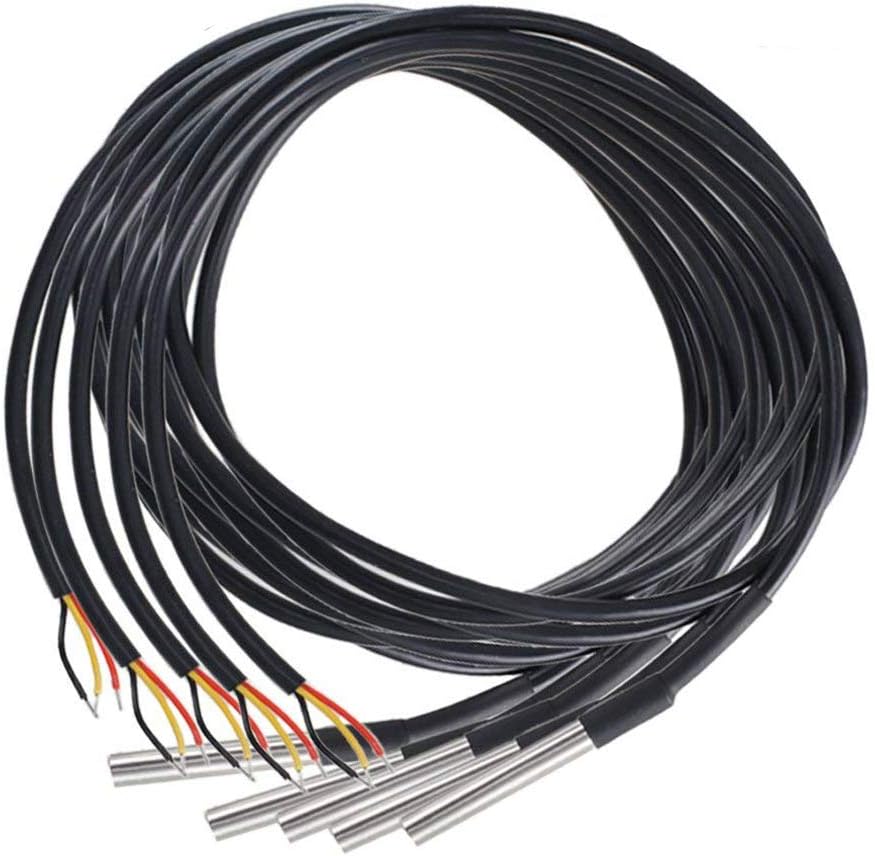
This pack includes five waterproof probes with one meter leads ideal for large scale monitoring. The DS18B20 provides accurate readings suitable for diverse environments.
Pros
Five waterproof units
One meter leads
Wide range support
Reliable brand
Cons
No adapter board
Basic packaging
We may earn a commission when you buy through this link, at no additional cost to you.
Users report success using these in greenhouses and aquaculture setups where moisture is common. The long leads facilitate placement in hard to reach spots.
Unlike other kits this does not include adapter boards so you may need to solder or use breadboards. This adds a small step to setup.
Buy this bulk pack for extensive projects requiring many sensors. It offers consistent quality across all five units.
Bulk Monitoring Ready
Five probes allow you to monitor multiple zones without buying individually.
Long Lead Advantage
One meter wires provide the reach needed to keep controllers away from heat or water.
The DHT22 offers a wider humidity range and better accuracy compared to the DHT11. It is a popular upgrade for users needing precise moisture measurements.
Pros
Full humidity range
Better accuracy
Wider temp range
Single wire data
Cons
Slightly slower speed
Two unit pack
We may earn a commission when you buy through this link, at no additional cost to you.
Users appreciate the full zero to one hundred percent humidity range which is useful for tropical environments. The accuracy is sufficient for most climate control systems.
The sensor is slightly larger and slower than newer I2C options but remains easy to use. It is a solid middle ground between budget and premium.
Choose this model if humidity tracking is critical to your project. It provides reliable data for weather stations and grow rooms.
Full Humidity Coverage
Zero to one hundred percent range allows measurement in any environment.
Better Accuracy
Improved accuracy over DHT11 makes it better for critical threshold monitoring.
These probes feature a stainless steel casing that offers excellent protection against corrosion and physical damage. The five unit pack provides good value for multiple sensors.
Pros
Stainless steel casing
Five unit pack
Wide range
Waterproof
Cons
Basic cable quality
No adapter
We may earn a commission when you buy through this link, at no additional cost to you.
Users find them durable for industrial use or heavy duty environments. The one meter cable allows flexible positioning in most scenarios.
The cable quality is basic so avoid high tension or high heat areas. For general use they are robust and reliable.
Select these for harsh environments where plastic probes might fail. They offer solid performance at a competitive price.
Corrosion Resistant
Stainless steel casing protects the sensor in wet or chemical environments.
Good Value Pack
Five units allow you to equip a large system without buying single probes.
We may earn a commission when you buy through this link, at no additional cost to you.
Buying Guide – How to Choose the Best Arduino Temperature Sensor
Selecting the right temperature sensor depends on several factors including required precision environmental conditions and communication needs. This guide helps you navigate the options to find the best fit for your project.
Temperature Range
Check the operating range to ensure it covers your expected environment. Some sensors only work from zero to fifty degrees while others handle extreme heat or cold.
Choose a model with a margin beyond your expected needs for reliability.
Accuracy Requirements
High precision applications require sensors with better tolerance like ±0.3°C. Standard hobby projects often accept ±2°C accuracy.
Evaluate if your project needs lab grade precision or just general monitoring.
Communication Protocol
Different sensors use digital one-wire or I2C protocols. I2C allows more devices on fewer pins while one-wire is simpler to wire.
Select the protocol that matches your board's available pins and library support.
Environmental Protection
If the sensor will be exposed to moisture choose a waterproof probe version. Plastic modules should only be used in dry indoor settings.
Waterproof stainless steel probes are essential for tanks or outdoor weather stations.
Voltage Compatibility
Ensure the sensor works with your Arduino's logic voltage. Some operate on 3.3V while others require 5V.
Mismatched voltage can damage the sensor or cause erratic readings.
Power Consumption
Battery powered projects benefit from low power sensors that enter sleep modes. Continuous power is less critical for wired mains applications.
Check current draw specs to extend battery life in portable devices.
Number of Units
Buying multi-packs is often more cost effective than single units. Ensure you need multiple units before buying larger bundles.
Check the bundle count to match your project scale and budget.
Additional Components
Some kits include adapter boards and resistors which simplify wiring. Others require you to source these parts separately.
Look for complete kits to save time on sourcing and assembly.
How to Use and Care for Your Arduino Temperature Sensor
Begin by connecting the sensor wires according to the voltage and data pin markings. Ensure the power connections match your board's specifications to avoid short circuits.
Install the required library through the Arduino IDE manager to enable data processing. Most digital sensors have standard libraries that simplify coding tasks.
Protect waterproof sensors from direct soldering heat and keep plastic modules dry. Regularly check connections for corrosion if used outdoors or in moist environments.
Frequently Asked Questions
What is the most accurate Arduino temperature sensor?
The Teyleten SHT31-D offers ±0.3°C accuracy which is among the highest for hobby sensors. For extreme precision industrial grade options may be needed but this is excellent for most projects.
Can I use a DS18B20 underwater?
Yes the DS18B20 with stainless steel waterproof casing is designed for submersion. Ensure the cable seal remains intact to prevent water from reaching the electronics.
Which sensor uses the fewest pins?
The DS18B20 and DHT11 use a single data pin plus power and ground. I2C sensors use two data pins which allows more devices on the same bus.
Do I need a resistor for the DS18B20?
Yes a pull-up resistor is required between the data and power pins to ensure stable communication. Many adapter boards include this resistor so check before buying.
What is the difference between DHT11 and DHT22?
The DHT22 has better accuracy and a wider humidity range. It is also slightly more expensive and slower than the DHT11 but offers more reliable readings.
How do I wire a DHT11 to Arduino?
Connect VCC to 5V or 3.3V GND to ground and DO to a digital pin. Add a 10k resistor between VCC and DO for stability.
Can I use these sensors with ESP32?
Yes all listed sensors work with ESP32 boards. Ensure the voltage logic matches the pin specifications for your ESP32 model.
Why is my temperature reading incorrect?
Check your resistor connections and verify the library matches your specific sensor. Ensure the sensor is not placed near heat sources like the processor.
Final Thoughts on Choosing the Best Arduino Temperature Sensor
We have covered ten reliable temperature sensors ranging from budget DHT11 packs to premium waterproof probes. Each option serves specific needs depending on your project requirements.
Prioritize waterproofing and accuracy if you are building for harsh environments. For basic indoor tasks the budget options are cost effective and simple to use.
Verify current prices and availability as these details can change frequently. With the right choice you can ensure reliable data for your Arduino projects.
This guide compares the top 10 magnetic jack pads for unibody vehicles, evaluating magnet strength, material durability, and pinch weld protection features.